
Expressvpn Glossary
Network slicing

What is network slicing?
Network slicing is a technique that divides a single physical network into multiple virtual networks, known as slices. Each slice operates independently while sharing the same underlying infrastructure.
Network slicing is a core feature of 5G architecture, spanning the 5G core network, transport network, and radio access network (RAN). It relies on automation and orchestration technologies to create, manage, and adjust slices dynamically based on demand.
How does network slicing work?
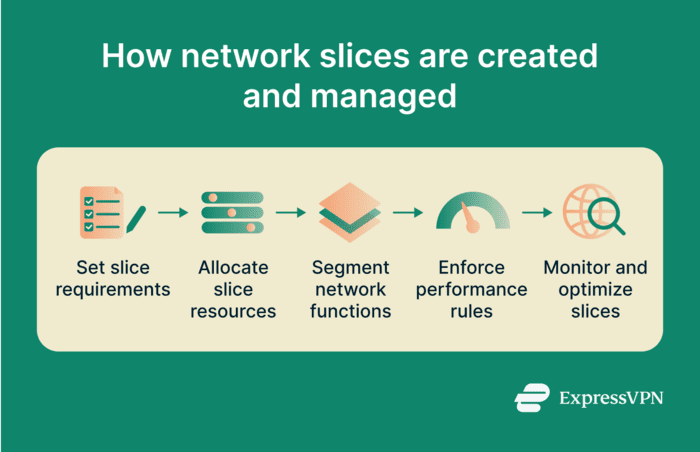
Here’s how network slicing operates inside a modern 5G-ready telecom network:
- Define slice templates and requirements: Operators create templates that specify performance, reliability, and security needs for each slice.
- Allocate compute, storage, and radio resources: The system assigns the right amount of processing power, storage, and wireless capacity to each slice.
- Use network function virtualization (NFV) and software-defined networking (SDN): These technologies virtualize and logically separate network functions, enabling independent control and management of each slice.
- Enforce Quality of Service (QoS), latency, and bandwidth targets: Performance policies ensure that each slice consistently meets its defined service levels.
- Monitor, scale, and self-heal slices: Automation tools watch slices in real time, scale resources up or down, and fix issues automatically.
Why is network slicing important?
Network slicing is important for the following reasons:
- Prevents “one-size-fits-all” networks: It lets operators tailor each virtual network to match the unique needs of different services.
- Improves reliability for critical services: By isolating slices, mission-critical applications get the performance required without interference from other traffic.
- Enables stronger isolation between tenants: Each slice runs independently, so one user or business can’t affect another’s performance or security.
- Reduces congestion with dedicated resources: Giving each slice its own resources helps avoid slowdowns and keeps services running smoothly.
- Supports privacy-sensitive enterprise use cases: Enterprises can put sensitive data and devices on dedicated slices with custom security, helping protect privacy and meet regulations.
Where is network slicing used?
Network slicing is used across industries that need tailored connectivity, including:
- Smart factories and devices.
- Public safety and emergency services.
- Connected cars and vehicle-to-everything (V2X) networks.
- Hospitals, remote monitoring, and telemedicine.
- Stadiums, events, and dense urban networks.
Risks and privacy concerns
Despite its benefits, network slicing can introduce security and privacy risks, such as:
- Misconfiguration breaks slice isolation: If operators set up slices incorrectly, one slice’s traffic or data can leak into others.
- Shared infrastructure enables side-channel risks: Because slices still share hardware and virtual resources, attackers can sometimes observe indirect signals (like timing or resource use).
- Weak APIs expose slice management planes: Poorly secured APIs that control slice creation and configuration can allow attackers to modify policies, disrupt services, or potentially take control of network slices.
- Supply chain flaws in virtual functions: Components from third-party vendors or open-source code can introduce hidden vulnerabilities that attackers exploit to infiltrate the network slice.
- Data exposure across tenants and logs: In multi-tenant environments, inadequate isolation or logging controls can allow one customer’s data to be viewed or intercepted by others.
Further reading
- What is IoT connectivity, and how do you choose the right solution?
- What are IoT networks? A complete guide
- IoT infrastructure: Components, architecture, and best practices
- IoT cloud security: Threats and best practices
- IoT in public safety: Applications and impact